
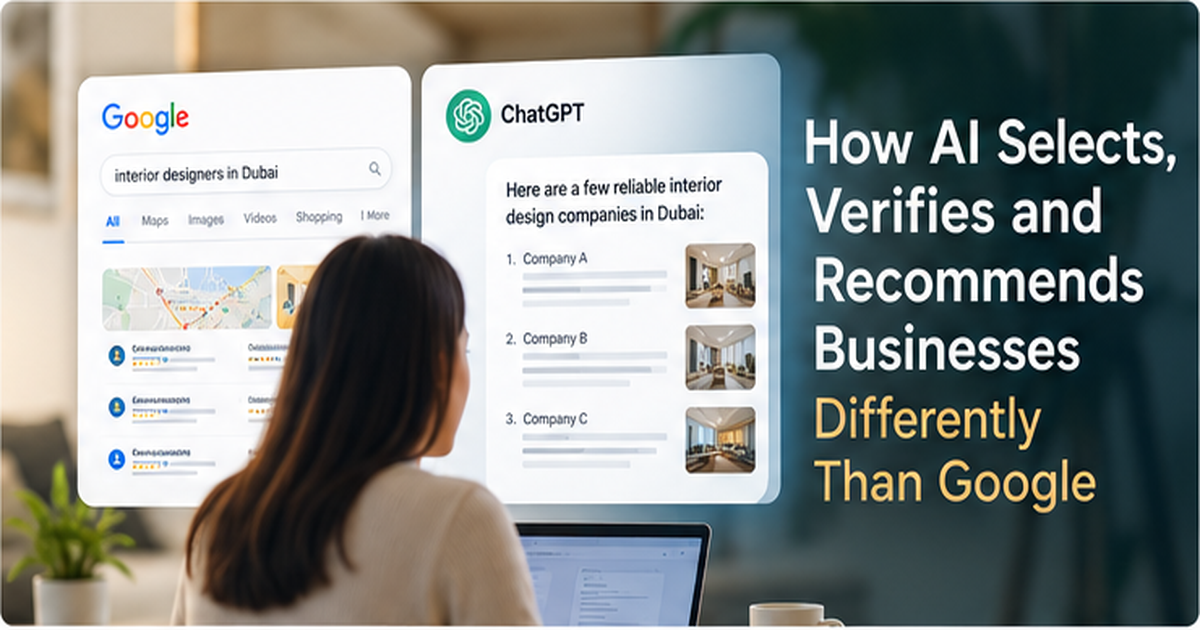
Imagine you’re looking for an interior design company in Dubai.
You open Google, search for interior designers, visit a few websites, read reviews, and shortlist some companies.
That’s how most of us have searched for businesses for years.
Now, there’s another option.
You can open ChatGPT and ask, “Can you recommend a few reliable interior design companies in Dubai that specialise in apartments?”
Instead of going through multiple websites, you may get a list of companies with brief explanations about their services.
Sounds convenient, doesn’t it?
But have you ever wondered why AI recommends certain businesses and leaves out others?
And what happens if your business ranks well on Google but doesn’t appear in AI recommendations?
To understand this, we first need to look at how Google Search and AI-powered search work.
Google Search vs AI Search: What’s Different?
Both Google and AI search tools help people find information. The difference is mainly in how that information is presented and used.
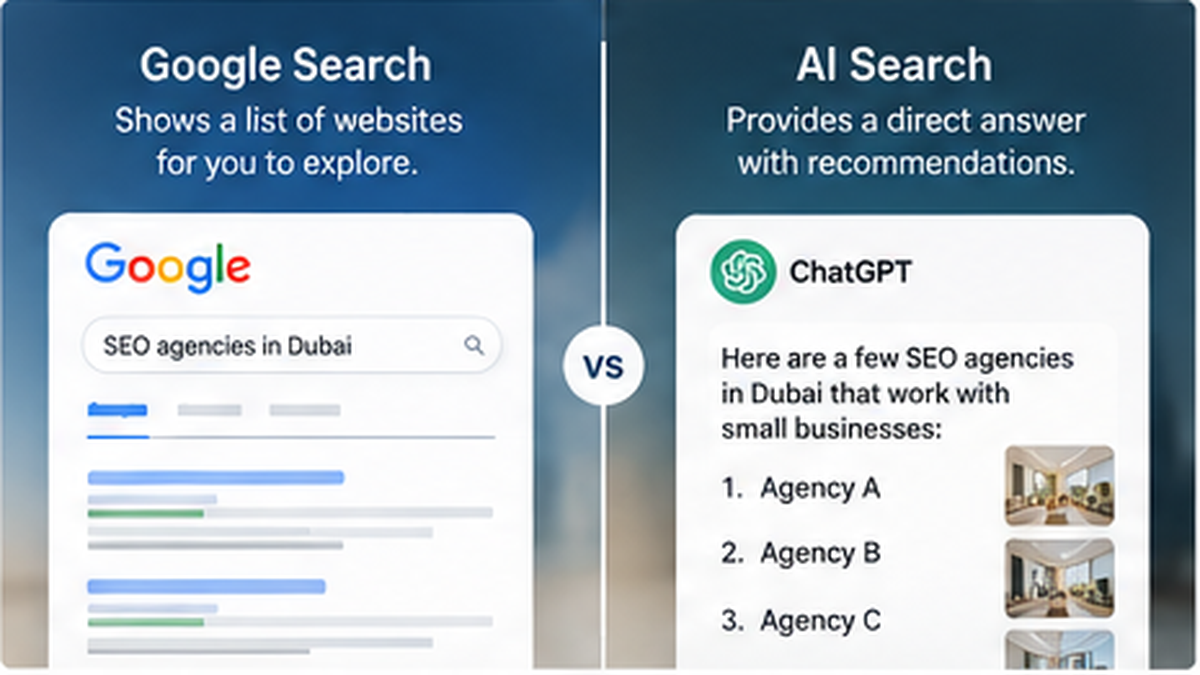
When you search Google for “SEO agencies in Dubai”, you’ll usually find a mix of websites, paid advertisements, and sometimes local business listings.
You can open those results, compare different agencies, and decide which ones to contact.
Now imagine asking ChatGPT:
“Can you suggest an SEO agency in Dubai that works with small businesses?”
The answer might include a few agencies, along with details about their services.
You may even ask follow-up questions without starting your research again.
Here’s a quick comparison.
Google Search | AI-Powered Search |
Displays websites, maps, ads, and other results | Can answer questions directly |
Users often visit several websites | AI can summarise information from different sources |
Ranking positions influence visibility | Mentions and citations also matter |
Searches are often keyword-based | Questions can be detailed and conversational |
Users compare businesses themselves | AI may help compare available options |
Of course, the distinction isn’t absolute.
Google itself has AI Overviews and AI Mode, which provide AI-generated answers within its search experience.
Google has also explained that some AI search features perform several related searches to gather information.
So, AI search isn’t replacing everything we know about search engines. It’s adding another way for people to discover businesses.
And that brings us to an important point.
A business that performs well in traditional search may not always appear in AI-generated recommendations.
How Does AI Search Find and Recommend Businesses?
There’s no single formula that every AI platform follows.
ChatGPT, Google AI Mode, Microsoft Copilot, and other AI tools have their own systems. Their methods and information sources can vary.
Some answers rely on information learned during AI model training. Others use fresh information retrieved from the web.
Let’s look at what may happen when someone asks AI to recommend a business.
AI Tries to Understand the Question
Think about these two searches:
- “Restaurants in Dubai”
- “Recommend an affordable vegetarian restaurant in Dubai that’s suitable for families”
The second question gives much more information.
The person wants vegetarian food, affordable prices, and a family-friendly environment.
An AI system can use these details to identify what kind of answer would be relevant.
This is why businesses should clearly explain their services, specialisations, and the customers they serve.
AI May Gather Information from Different Sources
Depending on the platform, AI search tools can retrieve information from websites, search indexes, and other accessible sources.
These may include:
- Official business websites
- Online business directories
- Local business listings
- Customer review platforms
- Industry publications
- News articles
- Other relevant websites
However, this doesn’t mean every AI platform checks all these sources before giving an answer.
The process depends on the platform, the question, and the information available.
AI Uses the Available Information to Prepare an Answer
Once relevant information is available, the AI system can prepare a response.
It may mention companies, describe their services, compare options, or provide links.
But there’s something business owners should understand.
An AI recommendation doesn’t necessarily mean the business has been independently verified.
AI tools can make mistakes. They might use outdated information or misunderstand what a company offers.
This makes it important to keep your business information accurate and easy to understand.
6 Areas That Can Help Improve AI Search Visibility
If you’re expecting a secret list of ChatGPT ranking factors, there isn’t one.
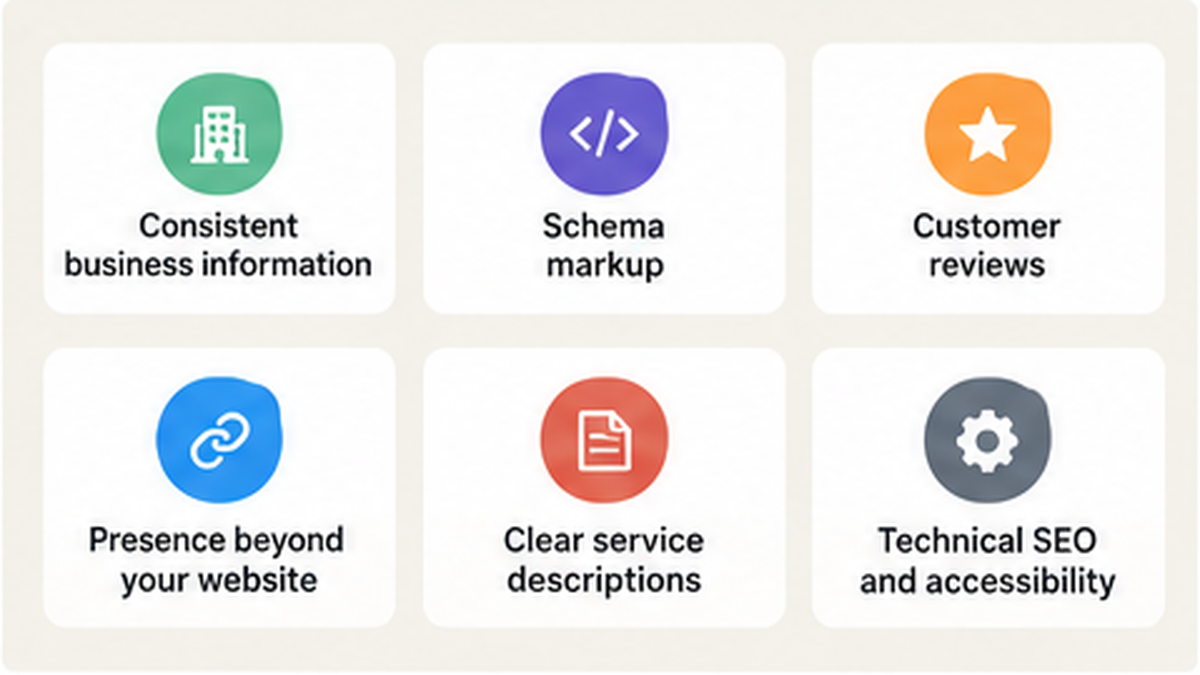
AI platforms haven’t published a universal formula that guarantees business recommendations.
Still, there are several areas worth improving. Many of them are already part of good SEO.
Keep Your Business Information Consistent
Let’s say you own ABC Interiors in Dubai.
Your website mentions ABC Interiors LLC, your Google Business Profile uses ABC Interior Design, and another directory has your old phone number.
A customer might recognise these as the same business, but inconsistent information can make it harder for search systems to connect the details confidently.
Check that your main business information is correct across important platforms.
This includes:
- Business name
- Website address
- Physical address or service area
- Contact number
- Business category
- Services offered
- Official social media profiles
You don’t need to make every sentence identical across platforms.
The important thing is that the facts match.
Use Relevant Schema Markup
Schema markup sounds complicated, but its purpose is fairly simple.
It adds structured information to a webpage so search engines can better understand certain details.
For example, a restaurant website may use LocalBusiness or Restaurant schema to describe its name, address, opening hours, and contact information.
Some commonly used schema types are:
Schema Type | What It Describes |
Organization | Company information and identity |
LocalBusiness | Business location and contact details |
Service | Services offered |
Product | Product information |
BreadcrumbList | Website page hierarchy |
However, adding schema doesn’t guarantee that AI will recommend your business.
Google has specifically stated that special AI-focused schema isn’t required for appearing in its AI search features.
Use schema where it’s relevant. Make sure it accurately reflects the information on your website.
Pay Attention to Customer Reviews
Before contacting a company, many people check what previous customers have said.
Would you choose a service provider without looking at its reputation?
Probably not.
Customer reviews can help people understand the quality of a company’s service.
For a cleaning company, customers might mention punctuality, professionalism, or attention to detail.
For a restaurant, they might discuss food quality, service, and atmosphere.
These details can be useful to people researching businesses.
So, encourage customers to share genuine feedback.
Also, respond professionally when someone leaves a review, whether it’s positive or negative.
One thing to remember: more five-star reviews don’t automatically mean more AI recommendations.
Different platforms may use review information differently.
Build a Presence Beyond Your Own Website
Your website is important, but it shouldn’t be the only place where people can find information about your company.
Imagine you’re researching a business and discover that it appears in relevant industry directories, professional associations, and publications.
That gives you more places to learn about the business.
The same information may also be accessible to search and AI systems.
Consider building a presence through:
- Relevant business directories
- Industry associations
- Local business communities
- Professional publications
- Genuine media coverage
- Trusted industry websites
Avoid submitting your business to hundreds of random directories.
Focus on platforms that are relevant to your industry and useful to potential customers.
Explain Your Services Clearly on Your Website
This is one of the most common problems I notice on business websites.
A company might have an attractive homepage filled with statements such as:
“We provide innovative solutions with unmatched excellence.”
It sounds professional, but what does the company actually do?
Now compare that with:
“We provide office fit-out, commercial interior design, and renovation services in Dubai.”
The second statement is much clearer.
Someone visiting the website immediately understands what the company offers.
Search engines can also interpret the information more easily.
Make sure your website answers basic questions:
- What does your business do?
- Which products or services do you offer?
- Who are your customers?
- Which locations do you serve?
- What experience do you have?
- How can someone contact you?
You can also add useful service pages, FAQs, and case studies.
Don’t write content only for Google or AI.
Write it for the people who might actually become your customers.
Make Sure Search Engines Can Access Your Website
There is little value in publishing useful content if important pages cannot be discovered.
Search engines use crawlers to find and process website content.
Some AI search providers also operate crawlers for search-related purposes.
For example, OpenAI documents a crawler called OAI-SearchBot, which helps websites appear in ChatGPT search results.
Your technical SEO should therefore include checks for:
- Important pages blocked in robots.txt
- Incorrect noindex tags
- Broken internal links
- Pages that cannot be crawled
- Content that search systems cannot easily access
- Important indexing problems
These are familiar SEO issues, but they remain relevant as search experiences evolve.
Allowing crawlers to access your website does not guarantee that AI tools will mention it.
It simply helps remove potential technical barriers.
Can Your Website Rank on Google but be Missing from AI Recommendations?
Yes, and there are several reasons why this can happen.
Suppose your company ranks well on Google for “interior design companies in Dubai.”
Now someone asks an AI assistant:
“Which interior design companies in Dubai specialise in luxury apartment renovations?”
That’s a more specific question.
Your website might rank for the broad keyword but have very little information about luxury apartment renovation projects.
Another company may have detailed service pages and relevant project examples.
Depending on the sources retrieved, the AI tool might mention that company instead.
There are other possible reasons too.
Different sources: The AI platform may retrieve information from sources that differ from Google’s organic results.
Different questions: Small changes in wording can change which businesses are relevant.
Missing information: A company may not clearly explain the service a customer is asking about.
Variable results: AI answers can change across conversations, locations, platforms, and time.
So, if your business doesn’t appear in an AI recommendation, don’t immediately assume that your SEO has failed.
Instead, investigate where the information gap might be.
A Simple Example from Dubai
Let’s take another example.
A business owner wants to renovate an office in Dubai.
They search Google for:
“Commercial fit-out companies in Dubai”
They also ask ChatGPT:
“Can you recommend companies in Dubai that specialise in office renovations?”
The first search may display companies targeting the broader commercial fit-out keyword.
The AI question is more specific. It focuses on office renovation.
A company with detailed pages about office renovation, commercial interiors, and completed projects may be easier to assess for that requirement.
This is only an illustration, not the result of a live experiment.
But it highlights something important.
Businesses need to explain their services in enough detail for both customers and search systems to understand them.
Simply mentioning “interior design services” on a homepage may not be enough to answer every relevant customer question.
How Can You Improve Your Business’s AI Search Visibility?
You don’t necessarily need a new website or a separate AI optimisation campaign.
In many cases, you can start by improving what you already have.
Here are some actions worth considering.
Action | Why It Matters |
Review your website content | Make your services and locations clearer |
Fix important technical SEO issues | Improve crawlability and discoverability |
Update business listings | Keep business information accurate |
Improve service pages | Explain your specialisations in more detail |
Add appropriate schema | Provide structured business information |
Encourage genuine reviews | Strengthen your public reputation |
Publish relevant case studies | Show your experience and completed work |
Answer customer questions | Make useful information easier to find |
Check AI search results | Understand how your business is currently represented |
You don’t need to work on everything at once.
For example, a local restaurant might first focus on its business listings, menu, and customer reviews.
A B2B consultancy may benefit more from improving its service descriptions, industry experience, and case studies.
The right approach depends on where your business stands today.
How to Check Whether AI is Recommending Your Business
You can start with a basic test.
Open ChatGPT, Google AI Mode, or another AI-powered search platform.
Instead of searching for your company name, ask questions that a potential customer might ask.
For example:
- “Recommend reliable SEO agencies in Dubai.”
- “Which companies offer office fit-out services in Dubai?”
- “Where can I find vegetarian restaurants in Dubai?”
- “Which photography studios provide corporate headshots in Dubai?”
Look at the results carefully.
Is your business mentioned?
If it is, are the services and other details correct?
If it isn’t, which businesses appear instead?
You can also check which websites the AI platform cites, when citations are available.
Repeat the test with different questions. Keep a record of the platform, date, location context, and results.
One answer doesn’t tell you everything about your AI visibility.
For more structured measurement, Bing Webmaster Tools also provides an AI Performance report for supported Microsoft AI experiences. It can help website owners review how their content is being cited.
Remember, a citation, a recommendation, and an actual customer enquiry are three different things.
Ultimately, you want visibility that supports business opportunities.
Do Businesses Need SEO and AI Visibility?
I don’t see this as a choice between SEO and AI visibility.
Businesses still need SEO.
Google continues to be an important channel for finding products, services, and local businesses.
At the same time, people can use AI tools to ask more detailed questions, compare options, and research companies.
The good news is that SEO and AI visibility share many foundations.
SEO | AI Visibility |
Helps improve search discoverability | Helps businesses become discoverable in AI experiences |
Focuses on relevant search queries | Also considers conversational customer questions |
Includes technical SEO | Requires accessible, understandable information |
Benefits from useful content | Benefits from clear, relevant information |
Includes local SEO and business listings | Can benefit from accurate business identity |
Measures rankings, traffic, and conversions | Can track mentions, citations, referrals, and enquiries |
Google also confirms that existing SEO best practices remain relevant to its AI search features.
So, instead of abandoning SEO and moving entirely towards AI optimisation, businesses should look at their overall digital presence.
At Virohaa, this is how we approach digital visibility.
We work on helping businesses become easier to find and understand across Google, local search, and AI-powered search experiences.
The objective isn’t simply to improve keyword positions. It’s to connect businesses with people looking for the services they offer.
What Do We Actually Know About AI Business Recommendations?
There is plenty of advice online about how to get recommended by ChatGPT and other AI tools.
Some of it is useful. Some of it is speculation.
It’s worth knowing the difference.
What we know:
- Google uses established SEO foundations for its AI search features.
- Some AI tools retrieve information from websites and search indexes.
- OpenAI operates a crawler for ChatGPT search discovery.
- Structured data helps search engines interpret certain webpage details.
- AI search tools may provide citations to supporting sources.
- Results can vary across different platforms and questions.
What we don’t know for certain:
- The complete ranking or selection formula used by every AI platform.
- Whether a particular number of reviews improves AI recommendations.
- Whether adding schema directly increases ChatGPT mentions.
- How much weight each platform gives to individual business signals.
This is why I would be cautious about anyone promising guaranteed AI rankings.
Good SEO has never been about tricks alone, and AI visibility shouldn’t be either.
Frequently Asked Questions (FAQs)
How does ChatGPT choose which businesses to recommend?
ChatGPT may use information from its training and, when search is used, information retrieved from online sources.
Its recommendations depend on the question, available information, and the system being used.
OpenAI hasn’t published a complete formula explaining how every business recommendation is selected.
Can I get my business recommended by ChatGPT?
You can improve your chances of being discovered and accurately understood by maintaining a clear website, accurate business details, and useful information across relevant online sources.
You should also make sure your website is accessible to relevant crawlers.
However, there’s no guaranteed method for appearing in ChatGPT recommendations.
Does schema markup help with AI search?
Schema helps search engines understand structured information about a webpage.
It can be useful for explaining business details, services, and other relevant information.
However, it doesn’t guarantee AI recommendations, and Google doesn’t require special AI-focused schema for its AI search features.
Do Google reviews affect AI search results?
Reviews can provide useful information about a business’s customer experience and reputation.
Some AI search experiences may use review-related information from available sources.
However, there is no universal rule that more Google reviews will result in more AI recommendations.
What’s the difference between SEO and GEO?
SEO stands for Search Engine Optimisation. It focuses on improving a website’s visibility and performance in search engines.
GEO stands for Generative Engine Optimisation. It focuses on improving how content and brands can be discovered, understood, and referenced by generative AI systems.
Both rely on strong content, technical accessibility, and credible information.
Can my business appear in AI search without ranking first on Google?
Yes.
AI-generated answers don’t always follow Google’s organic ranking order.
Different platforms may use different sources and respond to the context of the question.
Ranking first on Google isn’t a universal requirement for being mentioned by AI.
How long does AI search optimisation take?
There is no fixed timeline.
It depends on your website’s current condition, the improvements you make, the competition, and how different platforms access and use information.
It’s better to monitor progress over time than expect guaranteed results within a few weeks.
Final Thoughts
For years, businesses have focused on getting their websites to rank higher on Google.
That still matters.
But now, a potential customer might find your website through Google, discover your business on Maps, or come across your company while asking ChatGPT for recommendations.
Each of these creates an opportunity to be discovered.
The challenge is making sure your business information is clear, accurate, and accessible wherever customers are researching their options.
You don’t have to choose between SEO and AI visibility.
You need a digital presence that supports both.
And while nobody can guarantee that AI will recommend your business, you can certainly work on making it easier for search systems and customers to understand what you offer.
Being visible is important. Being understood and considered by the right customers matters even more.
Not Sure How Your Business Appears on Google and AI Search?
Your website might already be performing well on Google. But do you know how your business appears when customers use AI tools to research your services?
At Virohaa, we help businesses review their digital presence, identify gaps, and understand where improvements are needed.
If you’d like an independent assessment, explore our Digital Visibility Second Opinion or get in touch with Virohaa.